What 11 AI coding plans delivered in our setup
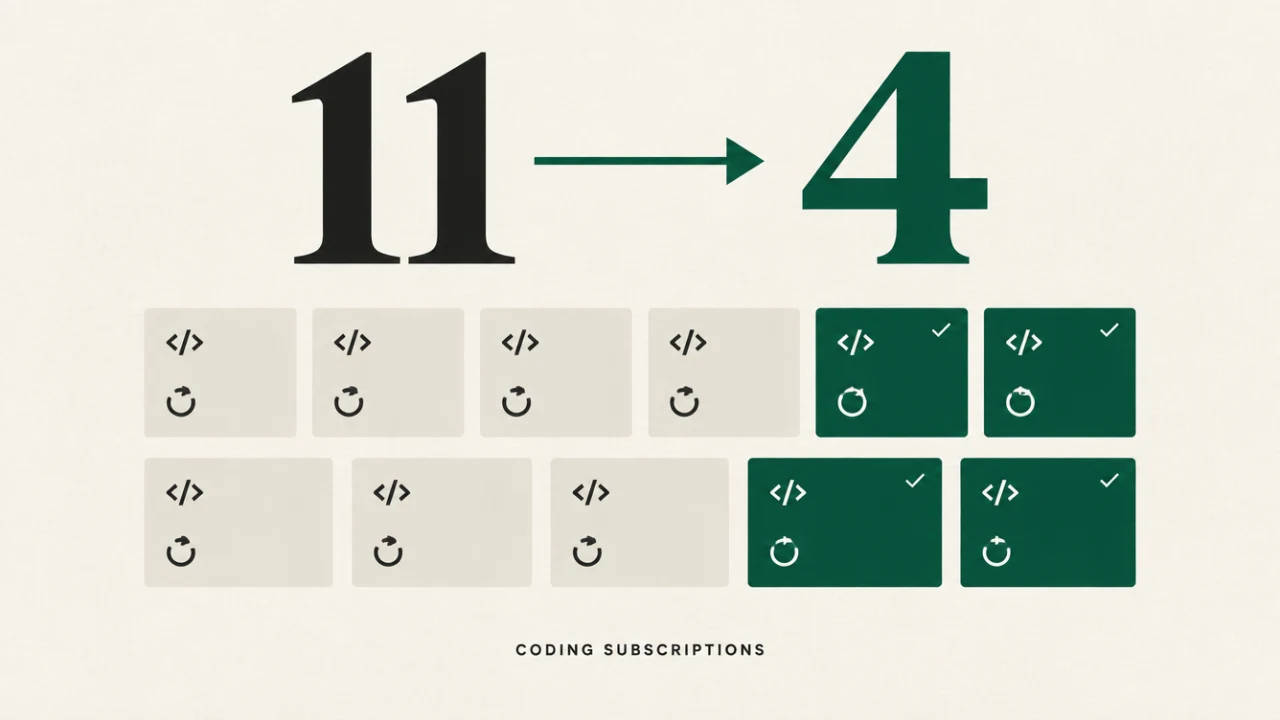
We compared 11 AI coding plans in our own development setup and chose four to keep. Some rows use provider or local-session telemetry; others are estimates from serialized sessions. The comparison describes our workload and billing windows. It does not establish which plan will deliver the best work for another team.
The short version: four subscriptions are worth keeping. Codex delivered roughly 22 billion tokens in a single month — about $14,000 of API-equivalent compute on $150-250 of subscription spend. MiniMax, Devin and Factory Droid each returned somewhere between 15x and 55x. The remaining plans were positive on paper but ran out of quota, expired, or turned out to be reselling the same open-weight models we were already getting elsewhere.[1][5]
How did we measure real token throughput?
All agent traffic in our setup flows through an LLM proxy plus the agents' own local session logs. That gives us per-provider request counts, model names, and token totals — including cache reads, which dominate agentic coding workloads because each turn resends the accumulated context. Token counts are therefore 'total context processed', not just novel input plus output.
Three honesty constraints before the numbers. First, everything is approximate: where providers don't export token telemetry (Factory Droid, SuperGrok, Cursor), we estimated from serialized session content and cumulative context resend. Second, 'value' means API-equivalent cost — what those tokens would have cost at published per-million-token API rates — not what they cost the provider to serve, and not a guarantee you'd have paid for them otherwise. Third, some subscriptions involved multiple accounts; the Codex row, for example, aggregates several ChatGPT accounts, and we folded the combined cost into the denominator.
One important disclaimer: these numbers measure throughput, not worth. They say nothing about model quality, harness quality, or how good the experience of using each tool actually is. This is pure token volume. The mix was real — smart models doing orchestration, workhorses doing the grinding. A billion tokens of a mediocre model is still a billion tokens of a mediocre model.
Each row in the table reflects that plan's best billing month, since most of these subscriptions were only alive for one or two cycles.
How throughput varied across our 11 plans
Each bar shows approximate processed tokens in that plan’s best billing month. The values include repeated context and cache reads.
Codex is a clear outlier at ~22.0B; the next highest row is MiniMax Plus at ~6.78B.
- Codex~22.0B tokens
Reported logs; several accounts
- MiniMax Plus~6.78B tokens
Reported logs
- Devin Pro~5.16B tokens
Reported logs; temporary free pool
- Factory Droid · estimate~3.0B tokens
Estimate
- GLM Coding Lite~0.71B tokens
Reported logs
- ClinePass~0.71B tokens
Reported logs
- Alibaba Token Plan~0.49B tokens
Reported logs
- SuperGrok · estimate~0.40B tokens
Estimate
- Cursor Pro · estimate~0.35B tokens
Estimate
- BytePlus Lite~0.24B tokens
Reported logs
- Mistral~0.06B tokens
Reported logs
The three estimates use serialized session records. Codex combines several accounts. This describes our throughput, not model quality, accepted work, or a general market ranking.
What did eleven subscriptions deliver?
The full audit, best billing month per plan. Token totals include cache reads, which dominate agentic coding traffic.[1][2][3][4][5]
- Codex — ~$150-250/mo across stacked ChatGPT accounts: ~22.0B tokens in August, ~120M tokens per dollar, roughly 60-95x API-equivalent ROI. Mostly gpt-5.6-class models.
- Devin Pro — $20/mo: ~5.16B tokens (4.90B on temporarily-free core models, 0.26B metered), ~48x. SWE-2 did the bulk of the work.
- Factory Droid (estimated) - $20/mo: approximately 3.0B tokens, roughly 55x API-equivalent value. We estimated throughput from serialized sessions; model-pool interpretation is not a provider billing report.
- MiniMax Plus — $20/mo: ~6.78B tokens, ~15x. MiniMax's own M3 model, sustained across two full billing months — the only subscription that never throttled us.
- Cursor Pro (estimated) - $20/mo: approximately 0.35B tokens, roughly 10x API-equivalent value. Estimated from serialized sessions, predominantly Composer in our local selection history.
- GLM Coding Lite — ~$16/mo: ~0.71B tokens, ~10x.
- SuperGrok (estimated) - $30/mo: approximately 0.40B tokens before our quota limit, roughly 10x API-equivalent value. Estimated from serialized sessions.
- Alibaba Token Plan — $18/mo: ~0.49B tokens, ~7x.
- ClinePass — ~$6.41/mo: ~0.71B tokens, ~5x.
- BytePlus Lite — $10/mo: ~0.24B tokens, ~2.7x.
- Mistral — ~$8/mo: ~0.06B tokens, ~10x — positive but negligible volume.
Which four did we keep?
Codex provided the largest recorded volume in our setup: about 22 billion tokens in one best-month window across several accounts. Most of that volume was repeated context and cache reads. The API-equivalent comparison is a way to describe that workload, not cash saved or a measure of accepted software.
MiniMax is the quiet workhorse. The $20 token plan served 6.8 billion tokens of M3 — not the smartest model in the stack, but capable of carrying almost any delegated workload, and the only plan that kept serving at volume for two consecutive months without hitting a wall. If a subscription's job is to absorb grind, this is the one that showed up every day.[5]
Devin and Factory Droid combined external models with their own model pools. Temporary free or subsidised access affected our best-month comparisons. Treat those conditions as historical observations; do not assume the same allowance will remain available.[2][3]
Cursor deserves an honest note: at ~0.35B tokens it did better per dollar than most of 'the rest', and we suspect we underused it — the bulk of that volume was their internal Composer model, which is priced into the plan almost as an afterthought.[4]
Why did the other seven fall short for us?
In our setup, the remaining plans encountered quota limits, expired access or too little usable capacity for the delegated workload. Some proxy requests continued after access expired. That is a monitoring and stop-condition failure to fix in our own tooling, rather than a reason to keep retrying failed requests.[10]
SuperGrok reached its limit within a day or two of one heavy thread in our setup. That observation concerns a particular workload and billing window, not a general promise about the plan.[6]
Are these plans secretly serving the same models?
Our model-selection logs showed overlapping open-weight models across several subscriptions. Model names in a local log are useful selection evidence; they do not establish a vendor's full serving architecture. Compare the model you actually selected, usable limits and accepted results before renewing.[7][8][9]
What does the subscription layer say about the frontier?
This comparison is a snapshot of our operating setup. It does not establish a general market ranking or the economics of a provider's infrastructure. Prices, models and allowances change; check current official terms before making a purchase.
Which plan should you actually buy?
- Start with the workload and the quality you need. A plan that produces more tokens is not necessarily producing more accepted work.
- Assign bounded work to a model that meets its acceptance checks. Include review time and failed attempts in the cost.
- Separate fresh input, cache reads and output in your usage records. Mark estimates explicitly.
- Check current official plan limits and the selected model before paying or renewing.
- Treat temporary free or subsidised access as a changing condition. Stop retries when access or quota is exhausted.
For procurement, pair usage evidence with accepted changes, quality, human review time and delivery cost. This is measurement discipline from our own product development; it is not a consulting-client case study.[11][13]
We're keeping four subscriptions and letting the rest expire. Yes, that's still a subscription problem — but at least now it's a measured one.[12][14]
| Plan | Monthly cost (USD) | Processed tokens | API value / plan cost | Basis |
|---|---|---|---|---|
| Codex | ~$150–250 | ~22.0B | ~60–95× | Reported logs; several accounts |
| Devin Pro | $20 | ~5.16B | ~48× | Reported logs; temporary free pool |
| Factory Droid | $20 | ~3.0B | ~55× | Estimate |
| MiniMax Plus | $20 | ~6.78B | ~15× | Reported logs |
| Cursor Pro | $20 | ~0.35B | ~10× | Estimate |
| GLM Coding Lite | ~$16 | ~0.71B | ~10× | Reported logs |
| SuperGrok | $30 | ~0.40B | ~10× | Estimate |
| Alibaba Token Plan | $18 | ~0.49B | ~7× | Reported logs |
| ClinePass | ~$6.41 | ~0.71B | ~5× | Reported logs |
| BytePlus Lite | $10 | ~0.24B | ~2.7× | Reported logs |
| Mistral | ~$8 | ~0.06B | ~10× | Reported logs |
Frequently asked questions
Are AI coding subscriptions worth it compared to API pricing?
For heavy agentic users, yes — dramatically. Our measurements show 10-95x API-equivalent value on the best plans when the subscription is actually saturated. For occasional users, a subscription you don't hammer is simply a donation; utilization, not price, determines ROI.
How is API-equivalent ROI calculated for a coding subscription?
Total tokens served during the billing window — including cache reads, which dominate agentic workloads — multiplied by the provider's published per-million-token API rates, divided by the subscription cost. It measures throughput arbitrage, not provider margin or guaranteed savings.
Which AI coding subscription delivered the most tokens?
Codex by a wide margin: roughly 22 billion tokens in August across several stacked ChatGPT accounts, equivalent to about $14,000 at API prices. MiniMax's $20 token plan was the best pure subscription, serving ~6.8 billion tokens across two consecutive months without throttling.
Do AI coding plans serve each other's models?
Frequently, yes. We observed Alibaba's plan serving GLM, BytePlus serving DeepSeek, and aggregators like ClinePass serving mixed open-weight models. Much of the market is the same open-weight pool with different branding, so verify the actual model names in your own logs.
Want to know what your AI stack actually costs per delivered token?
Discuss your workload, its quality requirements and budget. Detailed usage analysis and recommendations are paid work.
Sources / further reading
- ChatGPT pricing (Plus / Pro / Business tiers), OpenAI, 2026Reference pricing for the ChatGPT accounts aggregated in the Codex row; API-equivalent value computed from published per-token rates.
- Devin pricing and plans, Cognition, 2026Devin Pro plan reference. Core/free model availability was temporary at time of measurement.
- Factory pricing (Droid plans), Factory AI, 2026Factory Droid throughput is an estimate from serialized sessions. Model-pool interpretation is not a provider billing report.
- Cursor pricing, Anysphere, 2026Cursor Pro throughput is an estimate from serialized sessions. Local selection history showed Composer-2.5 as the primary model.
- MiniMax open platform and token plans, MiniMax, 2026MiniMax token plan sustained ~6.8B tokens across two billing months — the only subscription that never hit a quota wall.
- Grok / SuperGrok subscriptions, xAI, 2026SuperGrok quota was exhausted within days inside a single agent thread.
- Alibaba Cloud Model Studio, Alibaba Cloud, 2026Our local selection logs included Qwen and GLM. This does not establish the provider's full serving architecture.
- BytePlus ModelArk, BytePlus, 2026Our local selection logs included DeepSeek and GLM-class models.
- Cline and ClinePass, Cline, 2026Our local selection logs included DeepSeek and GLM-class models.
- Mistral AI platform, Mistral AI, 2026Lowest-volume plan in our comparison; positive API-equivalent ratio with little absolute throughput.
- AI implementation services, Leapfrog AIPaid review, audit and pilot options for business workflows.
- AI use cases, Leapfrog AIBusiness workflows where teams can evaluate an AI implementation.
- AI audit vs AI pilot: which comes first, Leapfrog AIRelated comparison for teams deciding how to start.
- The AI business cycle, Leapfrog AIRelated reading on where AI spend is heading.